DevLog 03: Designing the Corporate Fleet
Designing the Corporate Fleet
Greetings, Commanders.
Last transmission I talked about how fleets move. This time I want to talk about what they're made of — because in Shattered Allegiance, "an enemy Destroyer" tells you almost nothing.
Here's a scenario that explains why.
Your scout frigate picks up an unknown contact at the edge of sensor range. Signature reads: Battleship-class hull. You've got three destroyers in orbit — enough to handle most threats, but a battleship is a different problem. You need to know what it's carrying.
When your sensors get a hard lock, the loadout resolves and your stomach drops. It's loaded with railguns — every hardpoint. Before you can pull your destroyers back, it's already in range. One volley deletes your lead destroyer. The second volley cripples another. Five seconds ago this was a winnable fight. Now you're just trying to save what's left.
That's the game. The hull class tells you the chassis. The loadout tells you the threat. You won't know what you're facing until you're already committed — and neither will your opponent.
The Five Hulls
Why five? Three hulls — light, medium, heavy — would force each class to cover too many roles, blurring the lines between them. Seven would create redundancy and leave the player wondering what the real difference is. Five gives each hull exactly one strategic identity: expansion, scouting, flexible combat, heavy combat/support, and ultimate firepower. When you see a ship on sensors, you know immediately what kind of problem it represents — even if you don't yet know the specifics.
Every ship starts as a blank chassis rolling out of your orbital Shipyard. The hull determines the fundamentals: structural integrity, base armor, sub-light speed, maneuverability, and — crucially — how many hardpoints it has. Everything else is your call.
Colony Ship. The only vessel that can land on an unoccupied asteroid and establish a new holding. Massive, slow, heavily armored — and completely unarmed. This is not an oversight. The original games gave colony ships a token weapon, and the result was predictable: players threw a colony ship at every empty rock and let it self-escort. Keeping it weaponless means expansion is a military decision. Every new colony is a fleet commitment — you must detach combat ships to escort it, and those ships aren't defending your existing holdings. You can't blanket the map with outposts without paying for it in vulnerability. It carries your colonial seed across hostile space, and once it arrives, it deploys a seed pod that forms your initial Core Hub. Protect it like your game depends on it, because it does.
Frigate. Fast, cheap, fragile. Frigates survive through maneuverability, not armor. They're your early-game workhorses — scouts, skirmishers, harassment platforms. A frigate with Survey Tools and Fuel Tanks can operate far beyond your borders, mapping enemy mining operations and never firing a shot. A frigate with point-defense weapons and Evasive Thrusters becomes a missile screen that can reposition to any threatened vector in seconds. Same hull. Completely different ship.
Destroyer. The backbone. Destroyers balance speed, armor, and firepower in a way that makes them the most flexible combat platform in the game. They brawl. They escort. They crack orbital defenses. A destroyer with armor-piercing cannons and reinforced hull is a line-holder that can trade punches with cruisers. A destroyer loaded entirely with point-defense turrets becomes an interceptor screen that turns enemy missile salvos into scrap metal.
Cruiser. This is where things get expensive. Cruisers are mobile command centers — slower than destroyers, but with significantly more hull integrity, heavier base armor, and enough hardpoints to run mixed loadouts. They're the first hull class where you can realistically equip both offensive weapons and fleet-support systems simultaneously. A cruiser can be an artillery platform sitting behind your formation picking off defense platforms, or a heavy brawler loaded with alloy armor and armor-piercing cannons that anchors your battle line.
Battleship. The fleet-ender. Battleships are so resource-intensive that building one means not building other things — you're making a strategic bet that this single platform will justify its cost. They're extremely slow and can't dodge anything, but they carry the heaviest armor in the game and can mount weapon configurations that wipe out entire squadrons or shatter colony infrastructure in a single volley. A battleship on the field changes the math of every engagement. The question is whether it'll survive long enough to fire.
The hidden cost is time. While your shipyard is cranking out one battleship, your opponent's shipyard is building three destroyers. When that battleship finally rolls out, it's terrifying. Until then, you're down three ships. The battleship bet is concentrated firepower beats distributed firepower — and both sides are playing different games until the hull hits the belt.
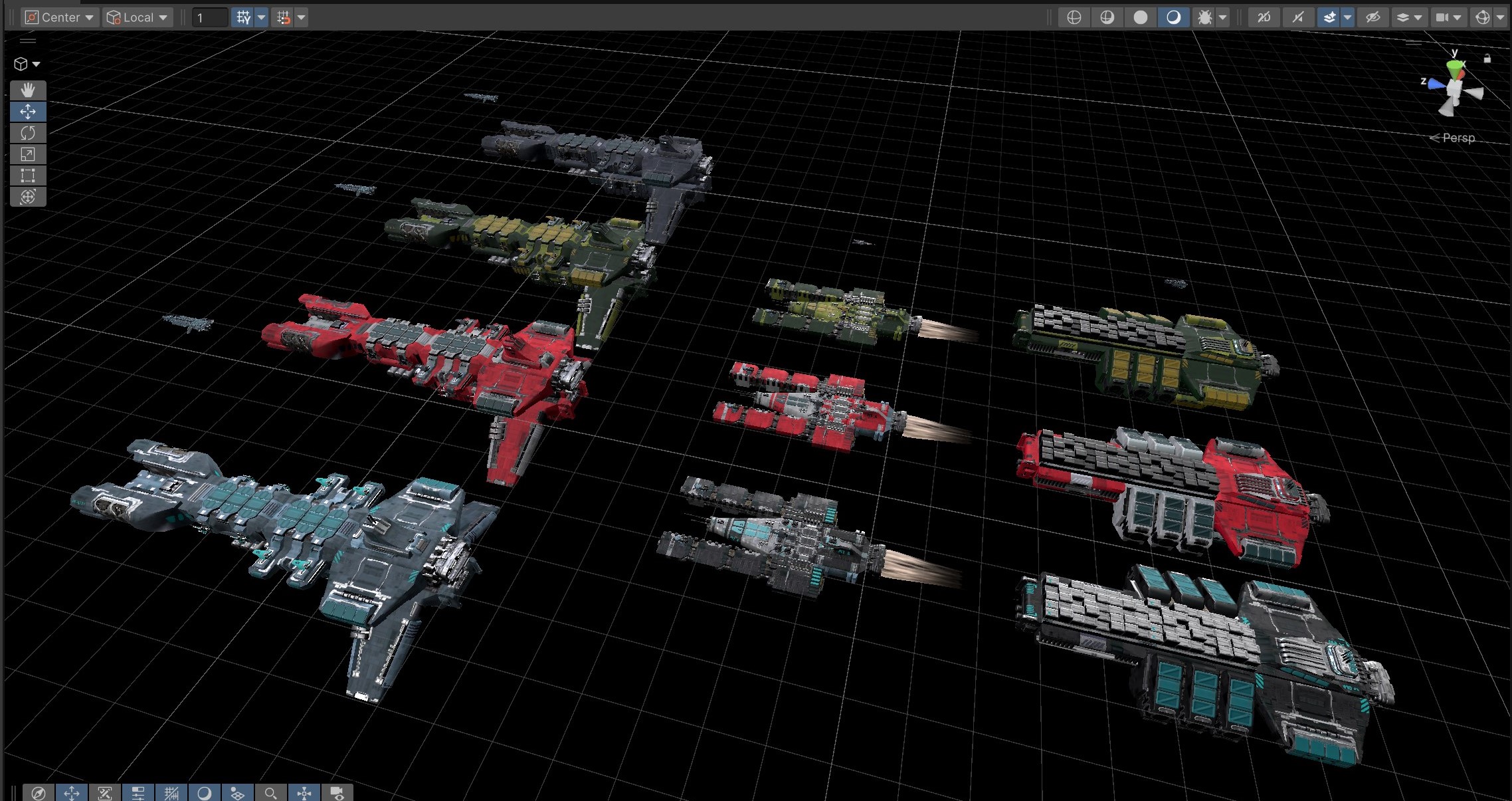 Early concepts showing the varying scale of the corporate fleet.
Weapons: Four Ways to Ruin Someone's Day
Weapons slot into hardpoints. Utility modules occupy separate internal slots — you don't choose between a railgun and a deflector shield; you can have both. This separate slot structure lets you build genuinely extreme configurations: a frigate with zero weapons and two survey modules is a viable strategic asset, not a failure state.
Combat isn't a DPS spreadsheet. Gunnery crews need lock acquisition time, rate of fire fluctuates under pressure, and every shot rolls against the target's evasion. It's about bringing the right tool to the right fight.
You have four core options. Point Defense turrets auto-target incoming missiles; a fleet without them dies to the first salvo. Bombs drop straight down and obliterate surface structures, but leave the bomber defenseless against interceptors. Homing torpedoes track fast-moving frigates but are slow enough to be swatted out of the sky. Beam weapons like the Railgun hit instantly, cutting down slow dreadnoughts before they can retreat.
You cannot counter everything at once. Your loadout is your tactical answer to the threat on the board.
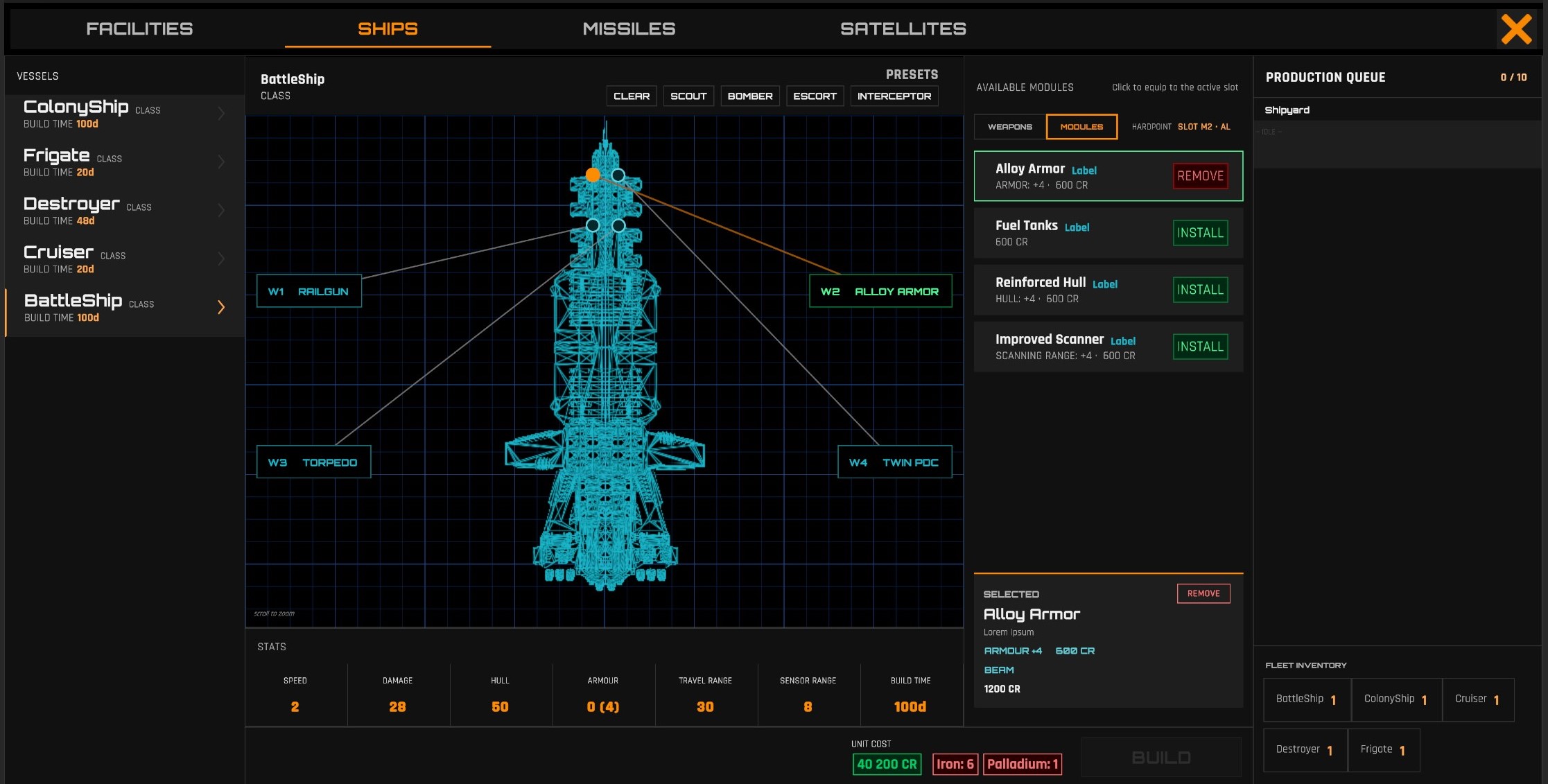 The shipyard interface. Weapons fill visible hardpoints while modules occupy internal bays — you see your loadout take shape.
Utility Modules: The Dilemmas of Design
Weapons kill things. Modules define how your ship operates, and this is where the real design tension lives. I'll highlight two specific design dilemmas that force you to make hard choices.
The Defense Dilemma: Armor vs. Shields Alloy Armor adds flat reduction to every incoming hit. Deflector Shields absorb a percentage of damage. This means neither defense is universally optimal. Flat reduction excels against many small hits (like point-defense chips or rapid-fire cannons). Percentage reduction excels against single massive hits (like railgun volleys). If your opponent is fielding railgun cruisers, an armor-heavy fleet is going to melt. The "best" defense requires scouting the enemy's offensive strategy.
The Reach Dilemma: Fuel Tanks Every ship has internal fuel reserves governing how far it can travel. External tanks extend that range. This is the strategic wildcard — fuel is the invisible border on your empire. The trade-off: Fuel Tanks help you reach the fight. Armor and shields help you survive it. A scout with Fuel Tanks can map three times as many asteroids, but if it gets caught, it dies instantly. Every slot spent on range is a slot not spent on survival.
Five Fleets, Five Philosophies
This combinatorial depth is what makes the system come alive. Same hulls, completely different doctrines.
Deep Space Scout: Frigate chassis. No weapons. Survey Tools and Fuel Tanks in every slot. Operates far beyond your borders, mapping the sector, never engaging. Cheap. Replaceable. Invaluable. Fatal weakness: dies to literally anything that catches it. If an enemy interceptor finds your scout, it's already gone.
Point-Defense Interceptor: Destroyer chassis. Point Defense in every hardpoint. Evasive Thrusters. Its job is to position itself between your capital ships and incoming missiles and create a wall of lead. Fatal weakness: PD turrets don't fire at ships. Against a direct-fire fleet, the interceptor contributes nothing — it's dead weight in a gunfight.
Artillery Cruiser: Cruiser chassis. Railguns in every hardpoint. Reinforced Bulkheads. Sits at the back of your formation, picking off defense platforms and enemy capital ships with instant-hit beam fire while your screen keeps it safe. Fatal weakness: zero anti-missile coverage. A single missile salvo that gets past your screen connects with full force.
Siege Bomber: Battleship chassis. Bomb weapons in every hardpoint. Alloy Armor and Reinforced Bulkheads. Slow. Vulnerable. If it reaches orbit over an enemy colony, every structure on the surface is a crater. The entire engagement revolves around whether it gets there. Fatal weakness: bombs can't target ships. The moment an enemy fleet intercepts it in transit, the siege bomber is a very expensive, very slow target.
Line Breaker: Destroyer chassis. Torpedoes in every hardpoint. Alloy Armor and Deflector Shields. Fast enough to close on a cruiser, tough enough to survive the approach, and hits hard enough to threaten ships twice its size. Send it in packs. Fatal weakness: torpedoes are the slowest warhead in the game. A PD interceptor screen will swat them out of the sky like target practice. The Line Breaker's approach is a clock — it has to reach firing range before its entire payload gets intercepted.
Rock, Paper, Scissors, Shipyard
Because every ship is built from modular components, the metagame is adaptive. If a rival corporation is spamming missile barrages, you retool your production lines to pump out point-defense interceptors. If they're fielding heavy, slow dreadnoughts, you build fast frigates with homing weapons that can orbit outside the dreadnought's firing arc and peck it apart.
Here's the catch: retooling takes time. You can't instantly switch from PD destroyers to torpedo frigates when you scout a battleship — there's a production delay gap between "I know what they're building" and "I can respond to what they're building." This raises the central strategic question: do you build generalist fleets that handle most threats adequately, or specialist fleets that dominate one threat completely? The answer depends on your scouting quality. If you see the enemy fleet composition early enough, retooling is a counterplay. If you see it too late, you're fighting the last war.
The shipyard isn't just where you build units. It's where you solve problems.
I'm deep in balance testing right now — which means a lot of fights where one side gets obliterated because I gave a battleship too many armor modules. The numbers will shift. The philosophy won't: you're not picking from a menu of pre-built units. You're designing your own answer to the threats you face, and your opponent is doing the same.
That's what makes the moment when sensor lock resolves — when you finally see what that enemy cruiser is actually carrying — so good. It's not a stat check. It's a reveal.
Stay vigilant.
- Jari
Deploy to the Front Lines
Early access intel delivered straight to your comms. Join the growing fleet of commanders preparing for deployment.