DevLog 02: Fleet Command & Missile Systems
Forging the Fleet
Greetings, Commanders.
Picture this: you've got six destroyers orbiting your primary mining colony. Intel reports an enemy carrier group vectoring toward your position — three cruisers, a battleship, and a screen of frigates. ETA: four minutes. Your defensive fleet is scattered across three different asteroids, mid-transit on supply runs. You've got one shot to regroup, form up, and intercept before they hit range.
That scenario isn't scripted. It's the kind of organic crisis this game is designed to generate. And the past month of development has been entirely about making sure you have the tools to answer it.
Fleets That Move Like Fleets
The fleet system is built around one rule: ships travel together or they die alone.
In most RTS games, giving a group move order is a suggestion — fast units reach the destination first, slow units straggle, and the group arrives in pieces. The player then micromanages each straggler back into formation. This works for ground-based RTS. It doesn't work here, because stragglers in open space don't just arrive late — they arrive alone, and alone is dead. Forcing fleet synchronization removes that micro burden, but the real design trade-off is more interesting: splitting off a frigate to scout ahead is no longer something that happens to you due to mismatched speeds. It requires deliberately breaking the ship out of the fleet. That transforms it from an annoyance into a tactical decision with consequences.
When you group ships into a fleet — any idle vessels at the same asteroid — they become a single tactical unit. The first ship you select becomes the Flagship, visually marked so you always know who's leading. From that point on, movement is synchronized.
The fleet throttles to the speed of its slowest member. This isn't just a convenience — it's a constraint. Adding a battleship to a frigate group doesn't just cost resources; it costs mobility. You can't have maximum firepower and maximum speed in the same fleet. That trade-off forces you to think about fleet composition as a strategic commitment, not just a bigger pile of ships.
Before departing, ships maneuver into a V-shaped wedge formation — flagship at the apex, wings covering the flanks — and they will not move out until every ship is in position. The wedge has a real mechanical effect: incoming missile fire hits the lead ship first, concentrating damage on the flagship while the wings stay protected. That means the ship you chose as flagship takes the brunt of the alpha strike, and the decision of which ship leads isn't just a cosmetic badge — it's your unit prioritizing who lives and who dies in the opening exchange. When they arrive at the destination, they don't scatter. They establish a synchronized defensive orbit around the asteroid.
When two fleets meet in combat, ships auto-target based on the logic of their loadout. Point Defense turrets prioritize incoming missiles. Beam weapons lock onto large, slow hulls they can't miss. Homing warheads track the most evasive targets. The player's tactical agency lives in fleet composition, positioning, and the decision to commit or retreat — not in clicking individual guns. This is an RTS where the real-time decisions happen at the strategic layer: which fleet moves where, what that fleet is made of, and whether the engagement is worth taking at all.
If a ship is destroyed, runs out of fuel, or you manually split it off, the fleet adjusts. Drop to one ship and the fleet disbands automatically. Select a subset of ships from an existing fleet and they break off as a new strike team mid-command.
Go back to that opening scenario. Those six destroyers, scattered across three asteroids — you box-select them, hit form fleet, and issue a single move order. They vector independently, form up mid-transit, and arrive at the intercept point as one coordinated strike group.
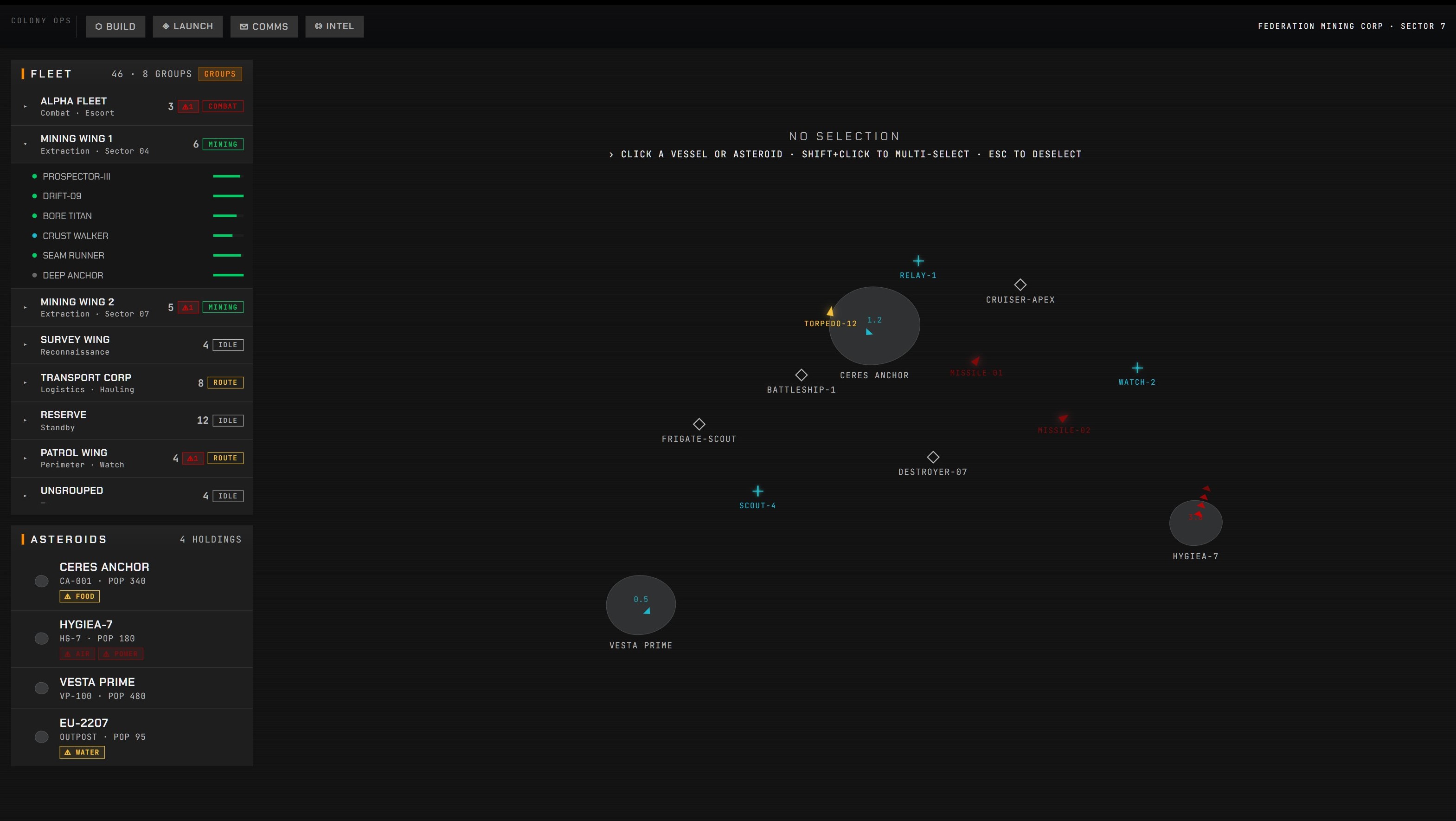 (Mockup) Fleet deployment panel showing ship grouping, flagship designation, and formation status.
The Missile Launch Sequence
Trade routes build your war machine. But if you want to tear down the enemy's, you skip the fleet and go straight for the silos.
When you order a missile strike, here's what actually happens:
You open the targeting interface, select your warhead type, and paint a target on the enemy colony. The game distributes the missiles across your operational silos. Then the show starts.
Three warhead types mean three different problems you're posing to the defender:
High Explosive — wide blast radius, moderate structure damage, low cost per missile. This is your workhorse. Fire enough HE and even a well-defended colony will lose buildings to the strays that make it through.
Incendiary — spreads on impact, kills population, leaves fire zones that block repair and construction. Incendiary doesn't destroy industry; it destroys the people running it. A colony that survives an incendiary strike may find itself with intact buildings and no one to operate them.
Nuclear — maximum blast radius, maximum damage, maximum cost, slowest flight speed. PDC turrets have the most time to track and intercept. A nuclear launch is a statement: you're betting enough warheads will survive the gauntlet that what lands will erase the colony.
Each warhead type has different resource costs, blast radii, and flight characteristics — which means the defender's response changes based on what's incoming.
The silo doors open. The missile ejects vertically, tilts toward its target vector, and the main thrusters ignite. It climbs out of the asteroid's gravity well and begins transit across the map.
This physical flight path is strictly mechanical. The 3D trajectory isn't there for spectacle; it is a timing window. When you see the angle of approach and the missile's velocity, you have the raw information needed to estimate time to impact. The defender has to decide instantly: is there time to reposition a fleet mid-transit to establish point-defense coverage over the targeted colony? The launch delay, the flight time, the physical approach — it's all a tactical countdown. The defender gets a brief window between "launch detected" and "impact." What you do with that window is the game.
Here's where it gets tense: the target colony sees it coming. When the missile descends on the asteroid, the enemy's point-defense turrets go active. If their PDC network is dense enough, your ballistic missiles might get intercepted before impact. You'll watch your salvo shrink, wondering if enough will break through to matter. If they break through, the missile hits the asteroid surface and the explosion tears through whatever was in its radius. That Solar Generator you spent five minutes positioning? Gone. The Shipyard with three destroyers queued? A crater. Now the colony's power grid is below demand. The water pumps are about to fail. The population is about to start dying. And you're watching all of it unfold from the other side of the sector, ten seconds after the flash.
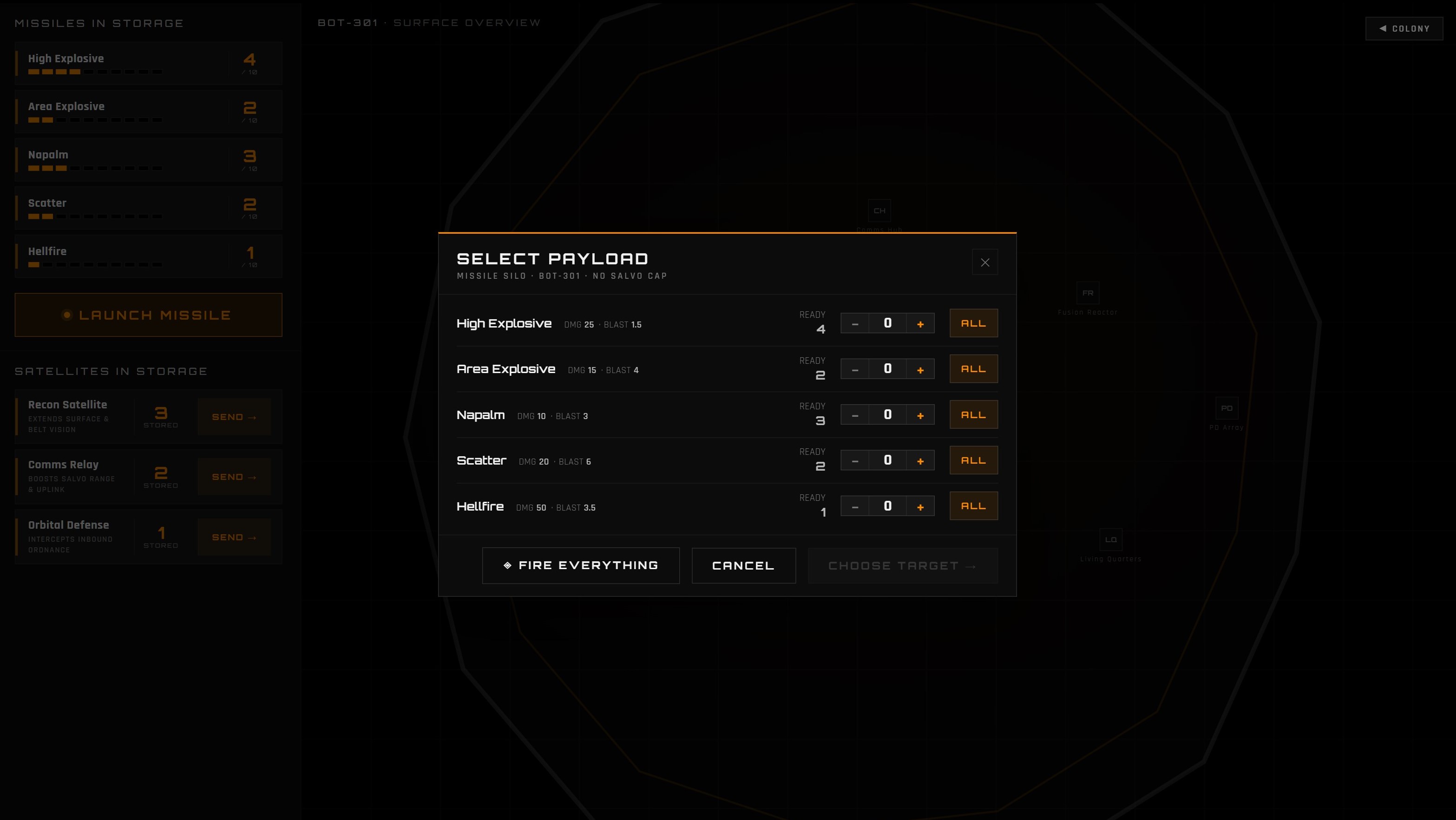 (Mockup) Prototype of the missile launch confirmation screen, hooking into the targeting event system.
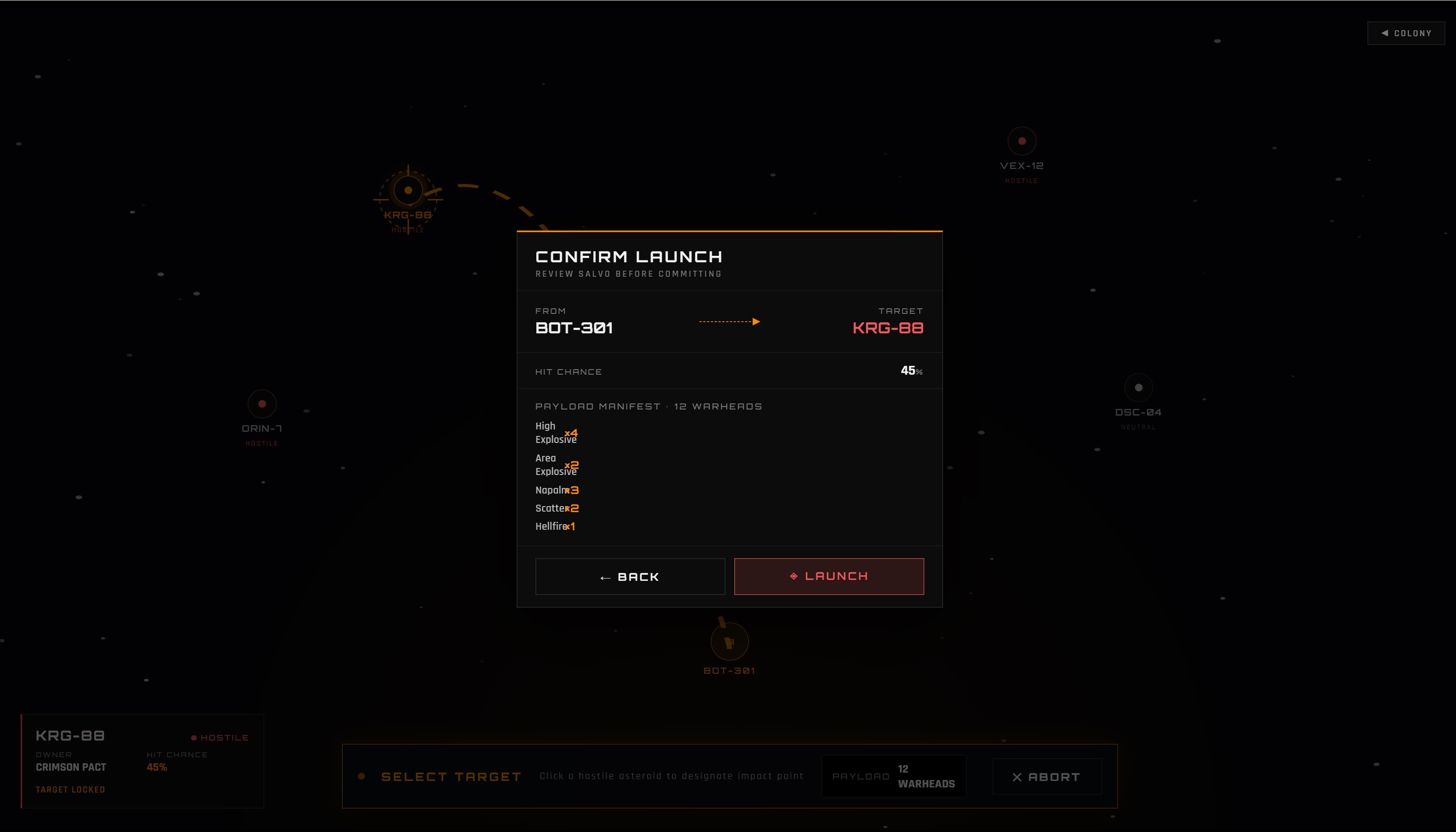 (Mockup) Visualizing the projected trajectory and estimated time to impact during the targeting phase.
What's Next
Ship design. The five hull classes are implemented, but the weapon and module customization system needs its own deep dive. That's the next transmission.
Signing out, Jari
Deploy to the Front Lines
Early access intel delivered straight to your comms. Join the growing fleet of commanders preparing for deployment.