DevLog 01: Initial Comm-Link Established
Sector Secured
Greetings, Commanders.
Your colonists don't care about your grand strategy. They care about air, water, and food. When your power grid dips, the water pumps go offline. The crops die. The air purifiers choke. Deaths trigger unrest, unrest triggers strikes, strikes halt production—and suddenly the colony you spent two hours building is starving and defenseless when a rival corporation's missile salvo arrives. Every system feeds into every other system. There are no isolated problems.
That is the reality of corporate warfare in the asteroid belt. It's a reality that strategy games haven't truly explored since the 90s, when games like Fragile Allegiance and K240 proved that logistics is warfare. They understood that the most terrifying weapon isn't a battleship—it's a broken supply chain.
That's the kind of game I'm building. That's Shattered Allegiance — a spiritual successor that preserves the soul of both originals under a new name.
Why This, Why Now
The 90s were a golden age for strange, ambitious strategy games — and a graveyard for most of them. Publishers chased trends, studios got absorbed, and entire sub-genres vanished without sequels or spiritual successors. The asteroid-colonization corporate warfare RTS was one of them.
Both K240 (1994) and Fragile Allegiance (1996) were abandoned. Developer Gremlin Interactive got absorbed shortly after, and the sub-genre died with it. No remasters, no re-releases, no spiritual successors. For twenty-five years, nothing.
That's long enough.
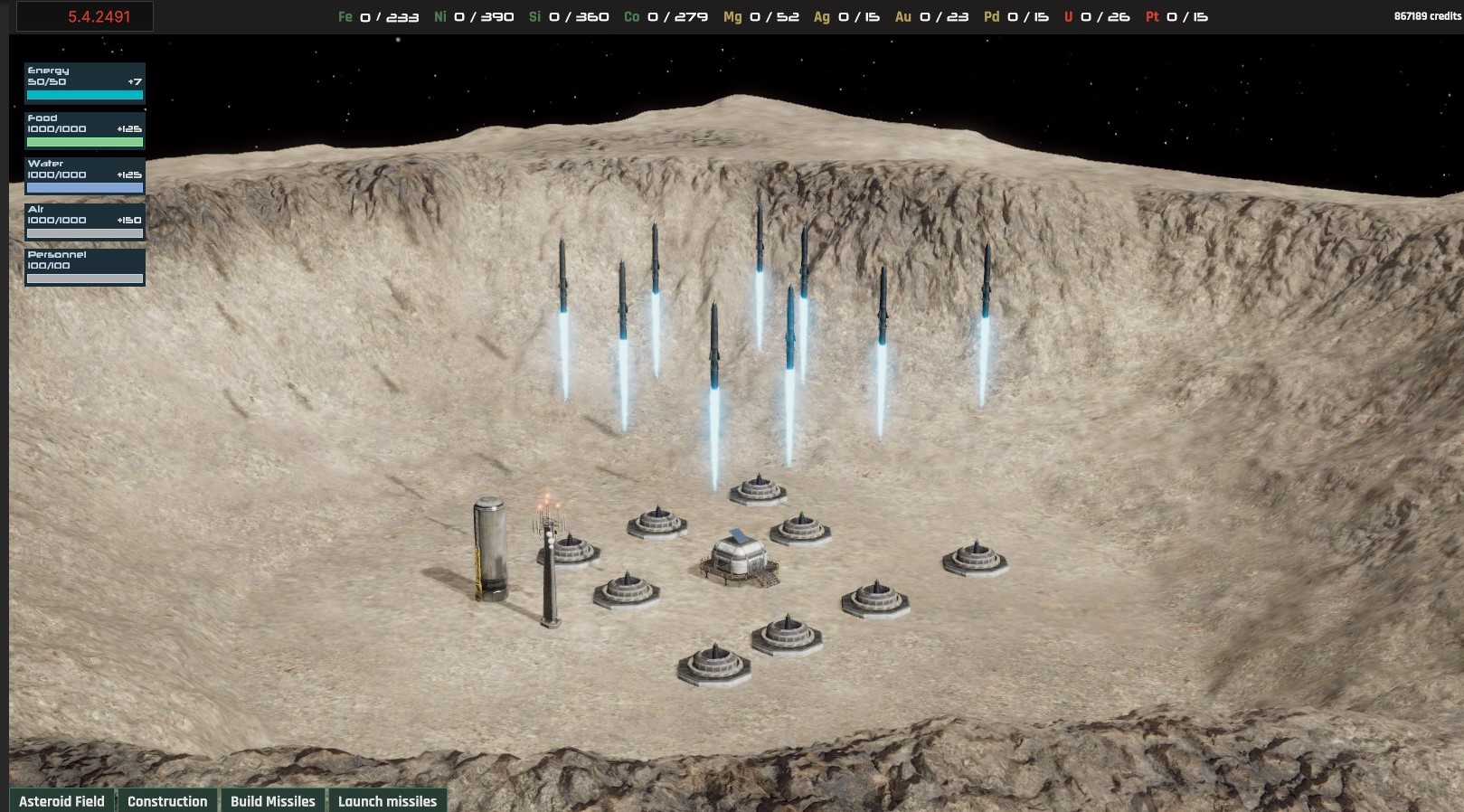 (Prototype) Early missile and launch system prototyping — the offensive side of the war machine.
What's Already Working
I'm building this solo in Unity. Here's what's functional right now:
Procedural asteroids. No two rocks are the same. Each one you claim will have its own topography, its own mineral distribution, its own problems. You'll learn to read them the way a captain reads the sea.
The life-support web. Air, water, food, power — each is produced by a specific building, consumed by your population, and stored in limited reserves. The connections are what make it dangerous. Power production feeds water pumps and air purifiers. If power output falls below demand, the whole chain seizes. A colony isn't a list of buildings; it's a balancing act where one failure cascades into another. The original games nailed this tension, and I'm preserving it.
Resource chains that demand decisions. Ore doesn't magically become credits. You mine it, stockpile it, sell it on the open market, or ship it to a colony that needs minerals for construction. Ore prices shift as the market moves. The economy is a weapon — if you can afford to stockpile when prices are low and sell when they spike, you'll fund wars that bankrupt your rivals.
The Hard Part
I'll be honest about what's not done: combat. Fleet movement, ship design, missile systems — they're all in active development right now, and I'll talk about them in future transmissions. The foundation (asteroids, colonies, life support, resources) is solid enough that I can finally turn my attention to the part where things explode.
Some indie devs would wait until the game looks "presentable" before showing anything. I think that's backwards. If you're the kind of player who cares about systems — about the rules governing a world, not just the spectacle — then you want to see the scaffolding. That's what this blog is.
What You Can Expect
I post roughly once a month. Each transmission will cover something real: a system I've built, a design problem I'm wrestling with, a feature that's working or failing. No hype. No "wishlist now on Steam" energy.
If you played K240 or Fragile Allegiance: you already know why this matters. If you didn't: welcome to a very specific, very deep corner of strategy gaming that's about to get its first new entry in a quarter-century.
Check the Roadmap to see the full plan.
Stay tuned.
- Jari
Deploy to the Front Lines
Early access intel delivered straight to your comms. Join the growing fleet of commanders preparing for deployment.